



Asteroid Observing Program Coordinator:John Goar |
  |
IntroductionThe Asteroid Observing Program’s purpose is to encourage amateur astronomers to learn to identify and observe asteroids. While the deep sky objects observable by amateurs remain the same, year after year, the asteroids (like the planets) are constantly moving against the background of the constellations. By learning to identify asteroids you will greatly enhance your observing skills. Since asteroids appear as points of light, rather than extended objects, they do not suffer from light pollution as much as deep sky objects. Hence an asteroid observing program can be carried out quite successfully from urban or suburban locations. Some amateurs who have mastered the asteroid observing techniques have gone on to make serious scientific contributions. These include:
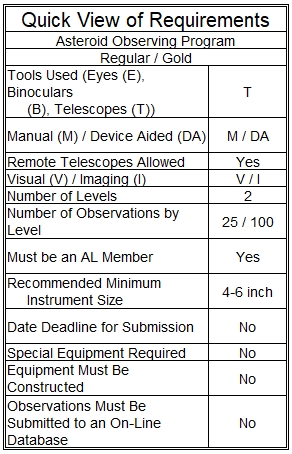
Each Observing Program has unique requirements. After reading this web page, and reviewing the Quick View of Requirements grid, if you have any questions about your equipment or how you plan to do your observations, please contact the Coordinator before you start observing. |
 |
Requirements and Rules
This certification is available to members of the Astronomical League, either through their local astronomical society or as members at large. If you are not a member and would like to become one, check with your local astronomical society, search for a local society on the Astronomical League Website, or join as a Member-At-Large at the AL Store.
The Asteroid Observing Program offers two levels of awards as shown below. Next to each level there is listed the minimum size telescope that may be needed to observe the specified number of asteroids.
| Certification | Asteroids Required | Award | Minimum Telescope Size |
| Silver | 25 | certificate | 4-inch |
| Gold | 100 | certificate & pin | 6-inch |
| To qualify for an Asteroid Observing Program Certificate, you must observe and confirm the required number of asteroids.
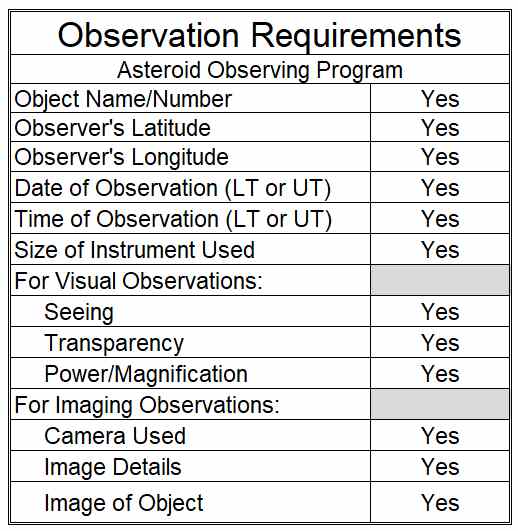
Your observations should be recorded in a notebook or on a computer and should include:
If working visually, each observation should include a sketch showing the position of the asteroid in relation to the nearby stars. Each asteroid must be observed at least twice in different positions, and at the time of the second observation, you must verify that the object is no longer in the position where it was observed the first time. If using CCD imaging, it is sufficient to either print the two positions or measure them and simply report the positions of the asteroid according to standard astrometric procedures. |
 |
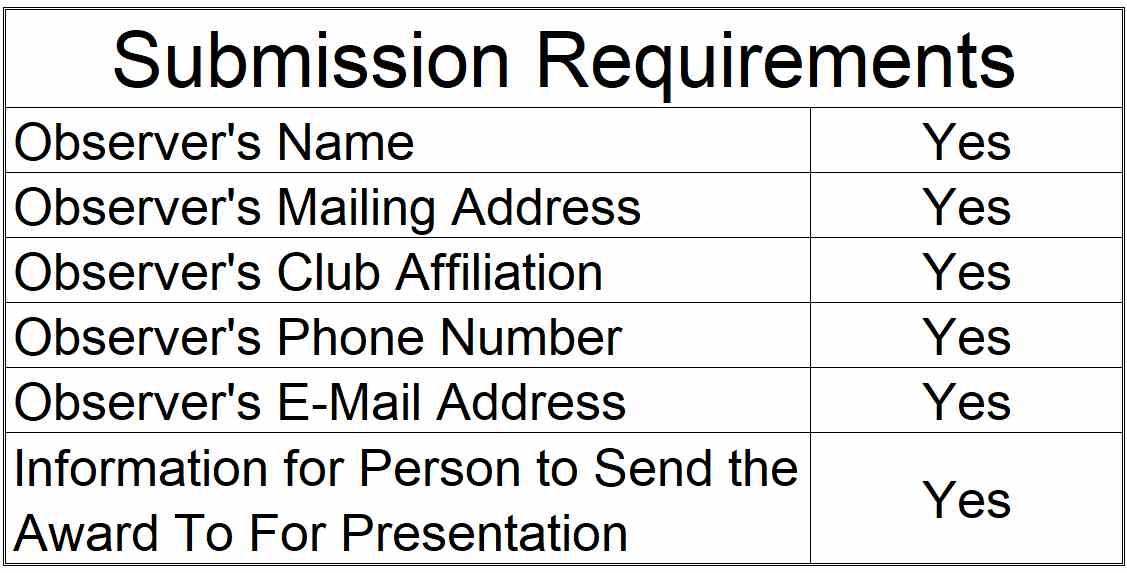
Submitting for CertificationTo receive your certificate and/or pin, mail or email a copy of your observations to the Observing Program Coordinator. Include your name, mailing address, email address, phone number, and society affiliation. Indicate to whom the certification should be sent. For the silver certificate (25 asteroids), copies of your sketches should also be submitted. Please send COPIES and retain the originals. If measuring astrometry of objects you may simply e-mail your report. If you wish to have the copies returned to you, include a self-addressed stamped envelope. |
 |
Asteroid Observing Program Coordinator:
John Goar
13569 NW Huntley Place
Silverdale, WA 98383
(360) 689-9149
E-mail: goarfamily@hotmail.com
Upon verification of your submission and of your active membership in the Astronomical League, your recognition (certificate, pin, etc.) will be sent to you or to the awards coordinator for your society, as you specified. Your name will also appear in an upcoming issue of the Reflector magazine and in the Astronomical League’s online database. Congratulations. Good luck with your next observing challenge.
Notes:
You may wish to obtain the publication for this Observing Program, “Guide to Asteroid“. It contains general information about asteroids, techniques and hints on how to find them, further information on how to sketch an asteroid’s position in a star field, and how to record observations.
There are many resources available for observing asteroids. The IAU Minor Planet Center maintains a web page that contains many resources to assist you in finding asteroid positions and help you develop a list of targets to observe.
There are numerous computerized planetarium programs that have asteroid features. Some of those are:
- SkyMap (SkyMap Software);
- Guide (Project Pluto);
- xephem (E. Downey);
- Home Planet (J. Walker);
- MyStars! (Relative Data Products);
- TheSky (Software Bisque);
- Starry Night (Sienna Software);
- Deep Space (D. S. Chandler);
- PC-TCS (D. Harvey);
- Earth Centered Universe (Nova Astronomics);
- Dance of the Planets (ARC);
- MegaStar V4.x (E.L.B. Software);
- SkyChart 2000.0 (Southern Stars Software);
- Voyager II (Carina Software);
- SkyTools (CapellaSoft);
- Autostar (Meade Instruments);
You can even go to the Minor Planet Center’s Minor Planet Ephemeris Service and download a file for any asteroid you may may wish to display on any of these programs and get a file back that allows you to track the asteroid in real time and print your own finder charts.
Asteroid observing can be great fun and if you have access to a CCD camera, it can be exciting to set up your own Observing Station and participate in the excitement of discovery and real science!
Links:
Other Asteroid Observing Program Links: