


Comet Observing Program Coordinator:Scott Kranz |
  |
IntroductionIn observing the wonders of the universe, there are perhaps no more wondrous and beautiful objects than comets. Since the invention of the telescope hundreds of years ago, astronomers have continually searched for new comets, and in the process, have discovered nebulas, star clusters, galaxies and more. Comets are important members of our solar system, and their study is important to mankind. Thus, having this Observing Program for members of the Astronomical League is important. We hope you enjoy your quest! Each Observing Program has unique requirements. After reading this web page, and reviewing the Quick View of Requirements grid, if you have any questions about your equipment or how you plan to do your observations, please contact the Coordinator before you start observing. Background InformationComet Tutorial:Unlike the other small bodies in the solar system, comets have been known since antiquity. There are Chinese records of Comet Halley going back to at least 240 BC. The famous Bayeux Tapestry, which commemorates the Norman Conquest of England in 1066, depicts an apparition of Comet Halley. |
 |
As of February 18, 2024, 4571 comets have been cataloged and their orbits at least roughly calculated. Of these, 471 are periodic comets (with orbital periods between 3.2 and 366 years); some of the remainder are no doubt periodic as well, but their orbits have not been determined with sufficient accuracy to tell for sure.
Comets are sometimes called “dirty snowballs”. They are a mixture of ices (both water and frozen gases) and dust that for some reason didn’t get incorporated into planets when the solar system was formed. This makes them very interesting as samples of the early history of the solar system.
When they are near the Sun and active, comets have several distinct parts:
- nucleus: relatively solid and stable, mostly ice and gas with a small amount of dust and other solids;
- coma: a dense cloud of water, carbon dioxide and other neutral gases sublimed from the nucleus;
- dust tail: up to 10 million km long composed of smoke-sized dust particles driven off the nucleus by escaping gases; this is the most prominent part of a comet to the unaided eye;
- ion tail: as much as several hundred million km long composed of plasma and laced with rays and streamers caused by interactions with the solar wind.
Comets are invisible except when they are near the Sun. Most comets have highly eccentric orbits that take them far beyond the orbit of Pluto; these are seen once and then disappear for millennia. Only the short- and intermediate-period comets, stay within the orbit of Pluto for a significant fraction of their orbits.
Comet Award Levels:
Observers can receive a certificate from the Astronomical League for two different levels of observations. A lapel pin will also be awarded for the Silver Level. The levels are:
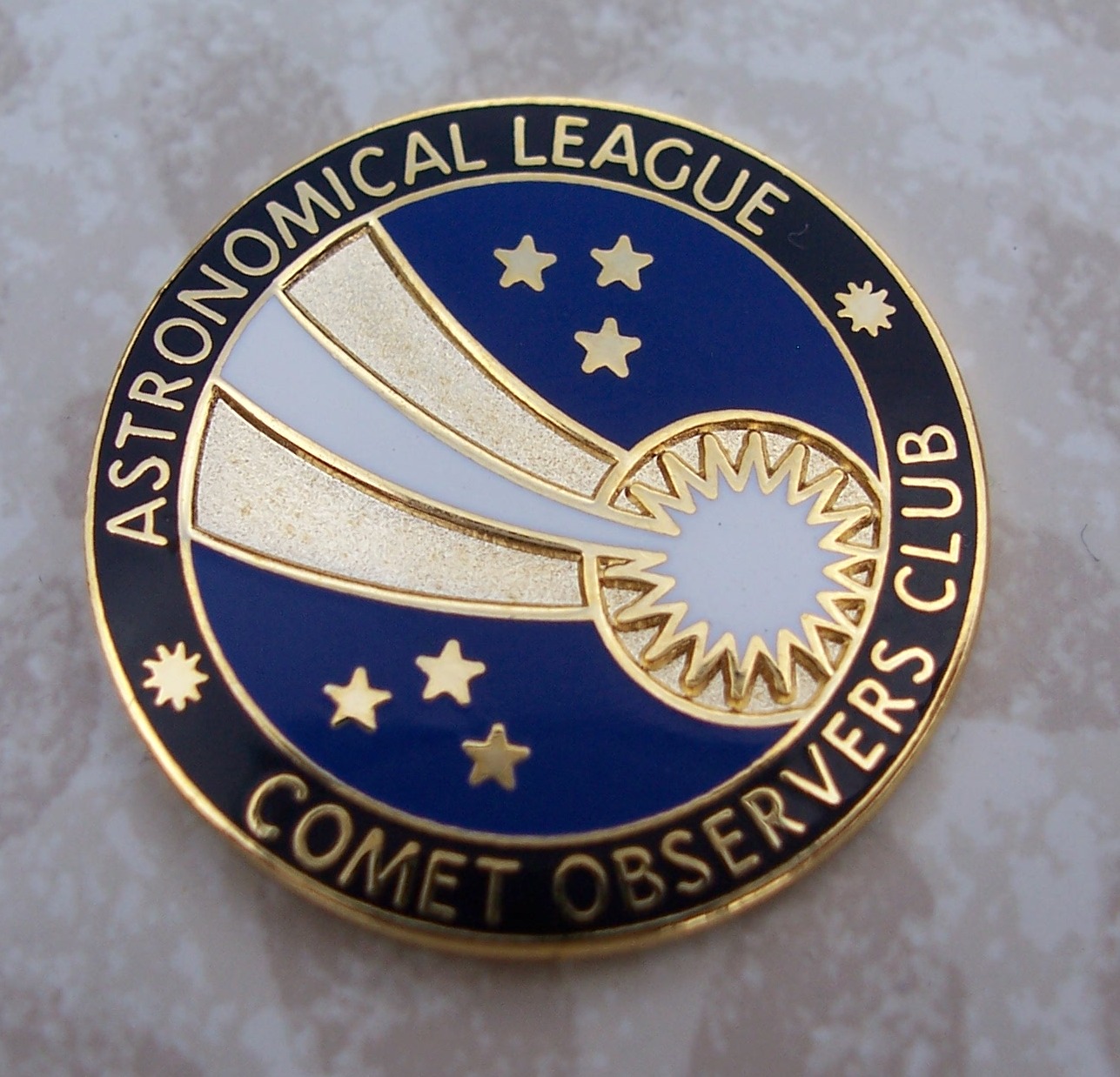
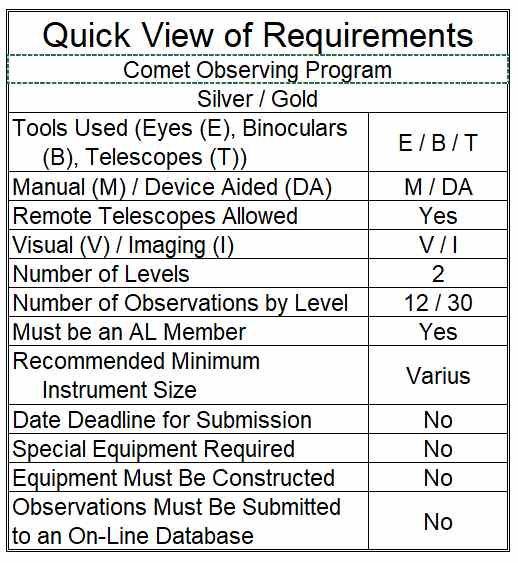
- Silver Level – observe at least 12 different comets.
Comets observed and logged can be of any magnitude. Two of these comets can be observed prior to January 1, 2001, assuming that all appropriate documentation is provided.
- Gold Level – observe at least 18 additional comets
Comets observed and logged can be of any magnitude. Two of these comets can be observed prior to January 1, 2001, assuming that all appropriate documentation is provided.
The observations can be accomplished through the use of:
- binoculars
- observatory telescope
- observer’s personal telescope
- or accessible robotic telescope
The observer can make these observations visually (eye to an eyepiece) and hand sketch the comet, or the observer can image the comet by using a camera and film or a CCD camera.
Requirements and Rules
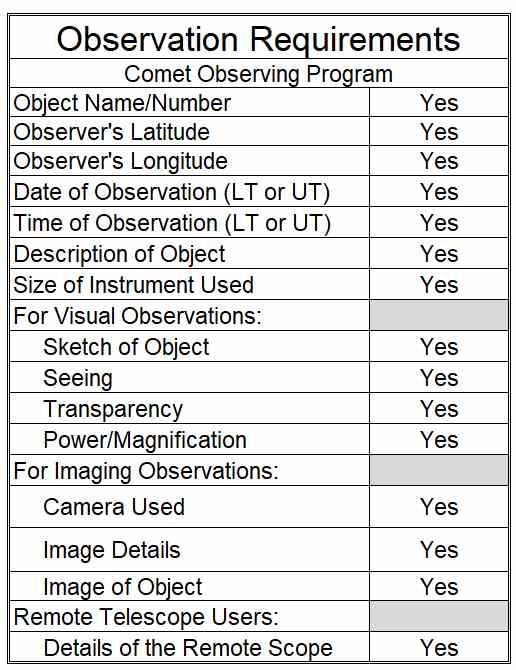
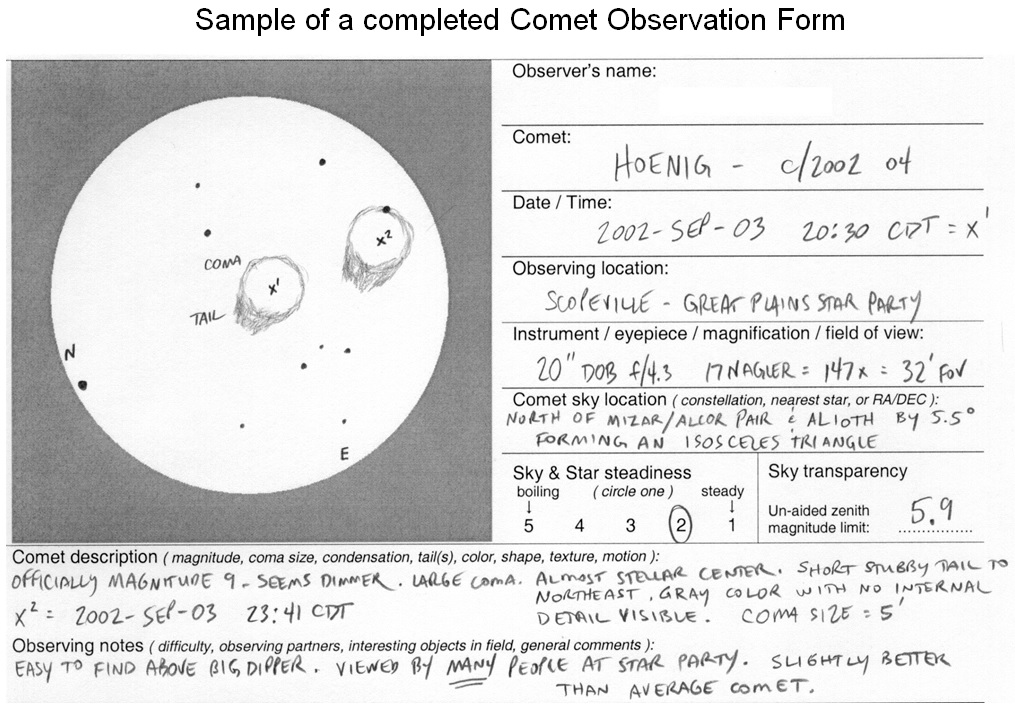
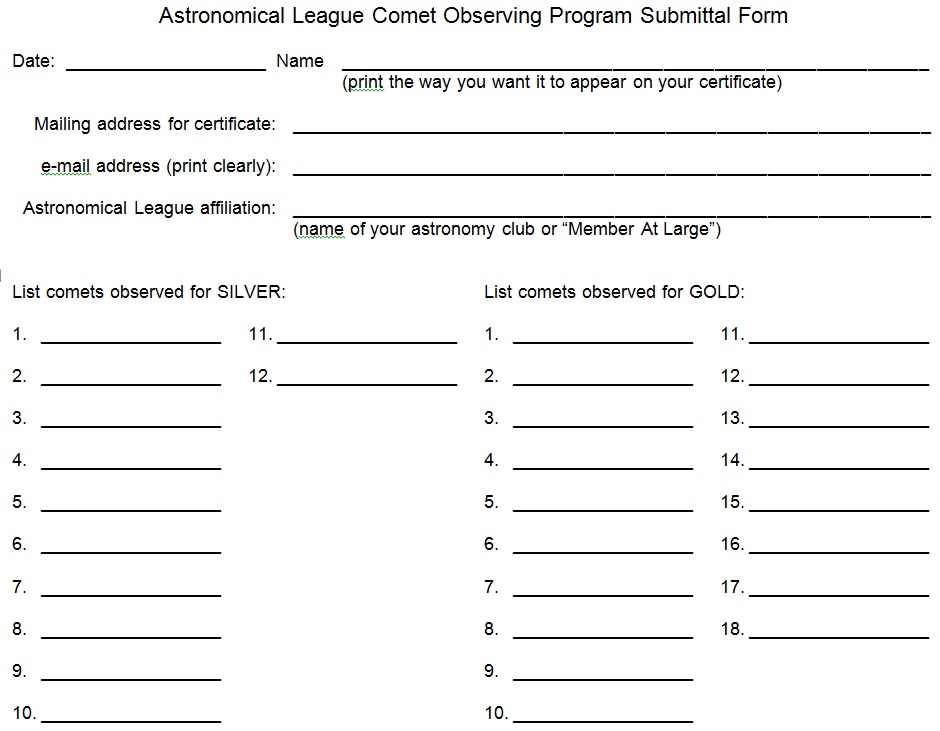
Requirements: Your observation log should be recorded in a notebook, hardcopy printout or some other method. You can also use the observing form attached. Whatever method you use to record your observations, the following information needs to be included:
Images and documentation can also be e-mailed to the Coordinator provided that the e-mail is not larger than 15MB in total size. |
 |
Rules:
This certification is available to members of the Astronomical League, either through their local astronomical society or as members at large. If you are not a member and would like to become one, check with your local astronomical society, search for a local society on the Astronomical League Website (click here), or join as a Member-At-Large in the AL Store.
The rules for obtaining a Comet Certification are:
- Observe the required number of comets as a group or individually.
- Each observer should keep his or her own data on the report form or own log system.
- The completed observing report should include the following submission index information:
- Observer’s Name
- Observer’s E-mail address
- Address of observer
- A listing of the comets included in the final submitted report
- To receive either the silver or gold comet observer award, the log and all the above-listed information must be sent to the Comet Observing Program Coordinator, for verification and NOT to an officer of your astronomy club.
Frequently Asked Questions
Here are the answers to your most frequently asked questions:
- Only 1 pin is given for both silver and gold awards, and it is sent with the silver certificate.
- There is a different certificate for the silver and gold levels.
- Each certificate (silver and gold) has a picture of the pin in the middle of the bottom.
- Comet observations can be used after 1/2001.
- 2 comets before 2001 can be used for silver. The total for this award is 12 comets.
- 2 comets before 2001 can be used for gold. The total for this award is 18 additional comets (beyond the silver’s 12 comets). In other words, once you have received the gold certificate, you will have observed and logged 30 comets in total.
- Awardees can mix and match sketches, CCD images and regular film pictures.
- The information and data and information should be sent to the Comet Observing Program Coordinator for verification.
- Awardees should also send their email address.
- Awardees should send only copies of their observations. Those submitted will not be returned unless postage is provided.
- Send in for silver when you have earned it and don’t wait for the gold.
- Awardees should also let the Comet Observing Program Coordinator know if they want the certificate sent to the award chairman of the club instead for presentation. Please include the email address, the names and US Mail addresses of both the awardee and your society’s award chairman. Please be very clear about where you wish your award certificate to be sent.
Submitting for Certification
| You must be a member of the Astronomical League in good standing, either through an affiliated society or as a Member-at-Large.
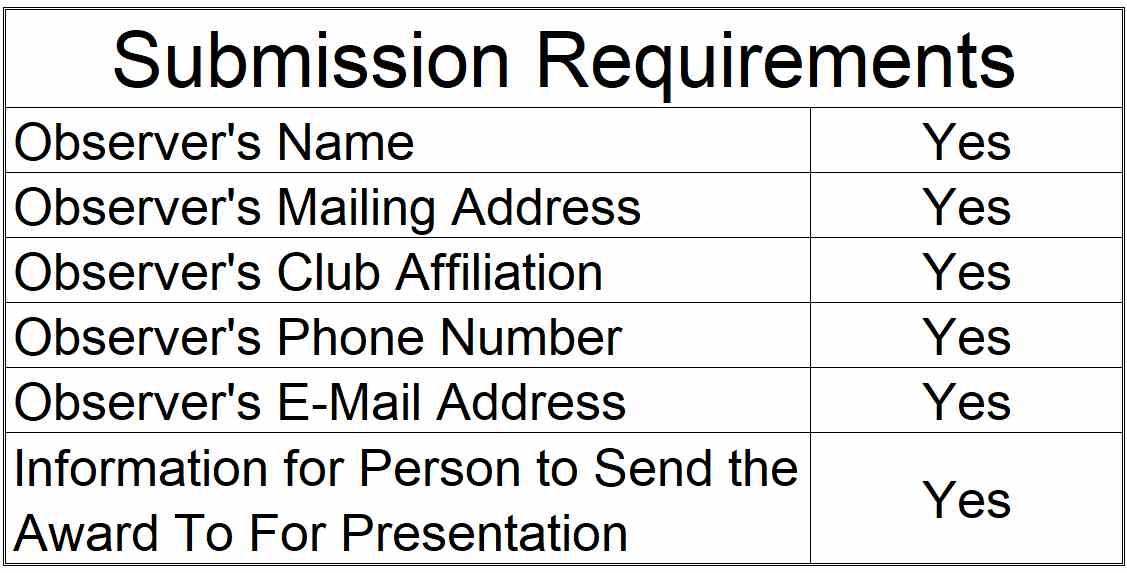
To receive your certificate and/or pin, mail or email a copy of your observations to the Observing Program Coordinator. Include your name, mailing address, email address, phone number, and society affiliation. Indicate to whom the certification should be sent. |
 |
Upon verification of your submission and of your active membership in the Astronomical League, your recognition (certificate, pin, etc.) will be sent to you or to the awards coordinator for your society, as you specified. Your name will also appear in an upcoming issue of the Reflector magazine and in the Astronomical League’s online database. Congratulations. Good luck with your next observing challenge.
Comet Observing Program Coordinator:
Scott Kranz
106 N Darrowby Drive
Raymore, MO 64083-9181
(816) 522-8921
E-mail: s.kranz1@comcast.net
Notes:
Acknowledgements:
Links:
View Comet Certificate Example:
Other Comet Program Links:
Resources:
This Observing Program wouldn’t be possible without the use of computers and the Internet. While none of the following resources are officially endorsed by the Astronomical League, many of them provide information that will be invaluable to program participants.
- Comet Chasing: http://cometchasing.skyhound.com/
- Weekly Bright comets: http://www.aerith.net/comet/weekly/current.html
- Kronk’s Comet page” http://cometography.com/
- Potentially observable comets: http://cfa-www.harvard.edu/iau/Headlines.html
- Sketching a comet: http://hou.lbl.gov/~vhoette/Comets/cometexp.html
- SOHO comet hunting: http://sungrazer.nascom.nasa.gov/
- Weekly bright comets: http://aerith.net/comet/weekly/current.html
- Yoshida’s home page: http://www.aerith.net/