



Double Star Observing Program Coordinator:Jon Schuchardt |
  |
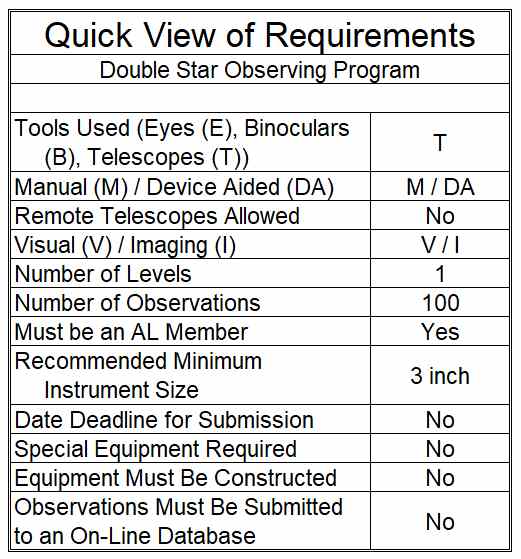
IntroductionWelcome to the Astronomical League’s Double Star Observing Program! This program introduces observers to many of the finest double and multiple-star systems in the heavens. You do not need an expensive apochromatic refractor to view the objects on this list; a small refractor, Newtonian reflector, or Schmidt-Cassegrain telescope will do just fine. All objects on this list were originally observed with a three-inch refractor using between 75X and 150X. The program is meant to allow you to enjoy a different aspect of our wonderful hobby and not to test your equipment. Double-star observing is forgiving. Clear, dark, or moonless skies are not usually needed for observing many if not most of these objects. As usual in astronomy, the best results will be obtained under optimum conditions, particularly under good seeing conditions for splitting close pairs. However, a less-than-perfect night should not dissuade you from getting outside to observe double stars and enjoying this program. Each Observing Program has unique requirements. After reading this web page, and reviewing the Quick View of Requirements grid, if you have any questions about your equipment or how you plan to do your observations, please contact the Coordinator before you start observing. |
 |
Requirements and Rules
This certification is available to members of the Astronomical League, either through their local astronomical society or as members at large. If you are not a member and would like to become one, check with your local astronomical society, search for a local society on the Astronomical League Website (click here), or join as a Member-At-Large in the AL Store.
| To qualify for the Astronomical League’s Double Star certificate and pin, observe 100 of the listed objects. You may choose any 100 from the list. Any telescope may be used, but one with a 60 mm or larger objective is recommended. Star hopping is preferred over “go-to” or “push-to” methods, but we will not insist on this if the rest of the observations are clear, well-documented, and unhurried. Because the equipment requirements for this program are modest, the use of remote telescopes is not allowed.
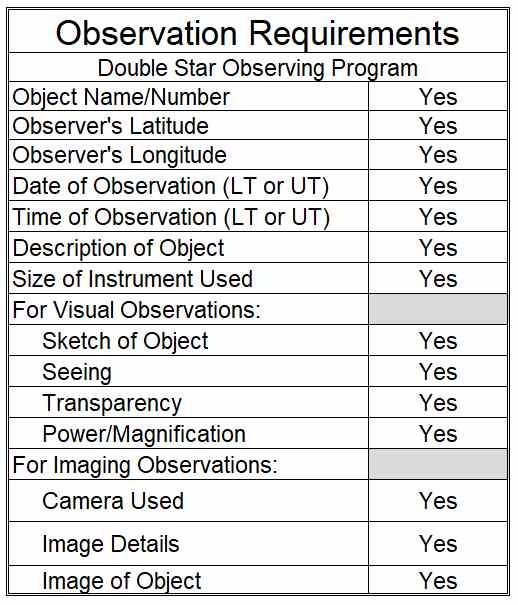
I encourage you to experiment with different magnifications because some double stars require substantial power and good seeing conditions to be cleanly separated. If you cannot split a close pair after a few tries on different nights, just log what you observed. To record your observations, use the log sheets linked below (Word or PDF) or use one of your own design that includes all of the required information. Log sheets must include: object name/number, date, time (local or UT), latitude and longitude, power(s) used, seeing (visual only), transparency (visual only), instrument used, camea used (imaging), details of the image (imaging), and a sketch or image. |
 |
The sketch or image need not be an artist’s rendering. They need to show dots for the stars, sized to indicate the difference in apparent magnitude and spaced to show how close together the stars appeared. The sketch and image must be marked to indicate N and either E or W. Your depiction also needs to show which star is the primary (brighter) star.
An important aspect of this program is teaching observers how to identify directions in the telescope and how to estimate the position angle for a pair of stars. Position angles are published in the League’s list and elsewhere, so compare what you saw with the accepted value for position angle. You should be able to estimate a position angle within about 20 degrees of the accepted value. A description is encouraged but is optional. What colors did you see? Was it tough to split the stars? Is it a showcase pair that requires revisiting, perhaps at a public star party?
When in doubt, “ask for directions.” Finding west in the telescope is easy. Turn off any tracking, center a star, and watch it drift out of view. The drift direction is always W. Equipment will dictate the direction of N. For a Newtonian reflector, N is 90° counterclockwise from W. For a Schmidt-Cassegrain (SCT) or a refractor – either one equipped with a typical star diagonal – N is 90° clockwise from W.
Pushing the telescope toward Polaris and watching the direction new stars enter the field is another popular way to find N, but this technique introduces an unwanted variable: how you pushed the scope versus simply watching the drift direction. Consequently, the drift method is inherently more reliable in finding W than the “push to Polaris” method.)
So how do we estimate the position angle (PA)? On your sketch of the star pair, with the primary star at the center, imagine a solid line from the primary star to N. Imagine a dotted line connecting the stars. Now trace an arc from the solid line to the dotted line from N to E. What is the angle? When the dimmer (secondary) star is due E of the primary star, the PA is 90 degrees; when the dimmer star is due S of the primary star, the PA is 180 degrees, and so on. Other angles can be estimated. When the stars have equal magnitudes, compare both possibilities and report the angle that has a lower value. When the stars are well separated, the PA is more easily judged; estimating PA for a close pair can be challenging.
Good luck and have fun!
For those interested in pursuing multiple-star systems, please consider the Astronomical League’s Multiple Star Observing Program: (https://www.astroleague.org/multiple-star-observing-program/). Stelle Doppie (https://www.stelledoppie.it/), a search engine to the Washington Double Star Catalog (WDS), provides current information on over 150,000 multiple star systems.
Submitting for Certification
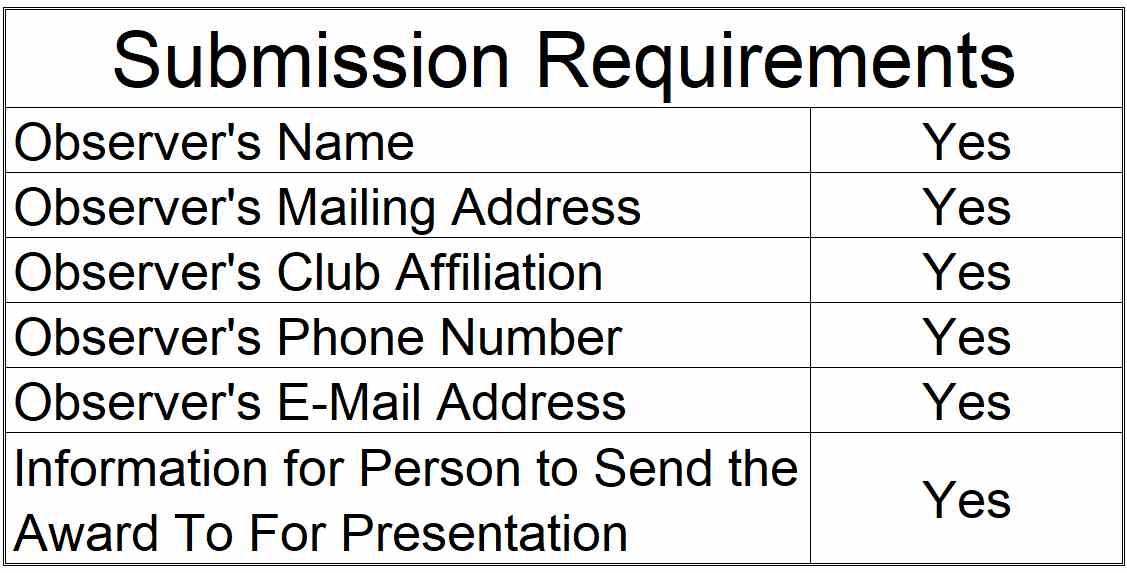
| To receive your certificate and/or pin, mail or email a copy of your 100 observations to the Observing Program Coordinator. Include your name, mailing address, email address, phone number, and society affiliation. Indicate to whom the certification should be sent.
I enjoy seeing what other amateur astronomers have done; it is my greatest reward as a program coordinator. However, it is acceptable to have another member of your club, who has already earned a Double Star certificate, review and approve your observations and send me confirmation by email. If your awards coordinator has not received the Double Star certificate, she or he must submit the observations to me or another awardee for verification. |
 |
If you have any questions or problems, please contact me the Coordinator by telephone, or email.
Upon verification of your submission and of your active membership in the Astronomical League, your recognition (certificate, pin, etc.) will be sent to you or to the awards coordinator for your society, as you specified. Your name will also appear in an upcoming issue of the Reflector magazine and in the Astronomical League’s online database. Congratulations. Good luck with your next observing challenge.
Double Star Observing Program Coordinator:
Links:
- Double Star Observing Program List by the Observing Program number (in PDF format) (in MS Excel format)
- Double Star Observing Program List by Right Ascension order (in PDF format) (in MS Excel format)
- Double Star Program Observation Log Sheet in PDF format
- Double Star Program Observation Log Sheet in Word format
- Find Your Double Star Program Award