



Planetary Nebula Observing Program Coordinator:Ted Forte |
  |
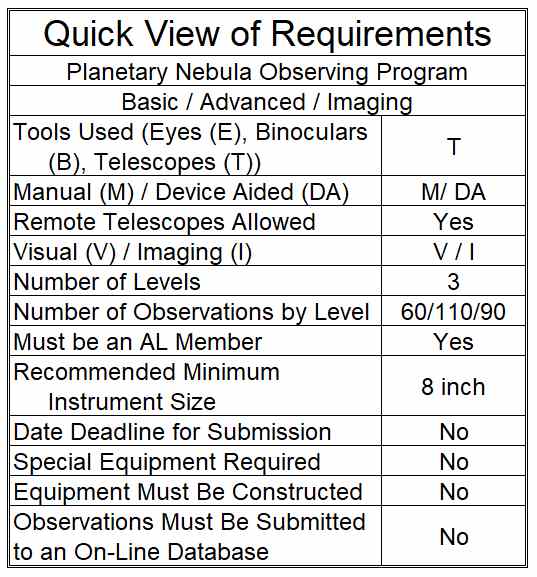
IntroductionWelcome to the Astronomical League’s Planetary Nebula Observing Program! Planetary Nebulae are perhaps the most interesting and beautiful objects in the heavens. A genre full of wonderful variation, they exhibit complex shapes, and may even show vibrant colors. The last hurrah of a sun-like star, their study is essential to the understanding of stellar evolution. If you don’t already have an appreciation for these most magnificent of objects, it is hoped this program will inspire you. We stand ready to welcome you into the ranks of the planetary nebula aficionado! Each Observing Program has unique requirements. After reading this web page, and reviewing the Quick View of Requirements grid, if you have any questions about your equipment or how you plan to do your observations, please contact the Coordinator before you start observing. |
 |
Background Information
The Catalog of Objects:
One hundred and ten planetary nebulae were chosen for this Observing Program. Among them are some of the most famous showpieces in the northern sky, but the list contains examples across the entire range of planetary nebula morphology. Some are tiny star-like points that will challenge you to pick them out of their crowded star fields. Others will appear as ghostly apparitions that will severely test your powers of observation. In addition, we have included four examples of “proto-planetary nebulae” as additional challenges.
This Observing Program was developed as a club project by the Back Bay Amateur Astronomers of southeastern Virginia and the original list contained only objects that rise above the horizon from there. The most southerly object on the list is at a declination of -40 degrees 26 minutes.
The Awards:
The Observing Program can be completed visually or by imaging. We have opted to make it possible for an observer to complete this Observing Program even if his telescope and the quality of the observing site make the detection of some of the objects impossible.
First, we offer two levels of accomplishment, Silver Level and Gold Level. The Silver Level should be achievable with very modest equipment and from less than dark sites. The Silver Level has a certificate only. To earn a certificate for the Silver Level you must observe at least 60 of the objects on the list.
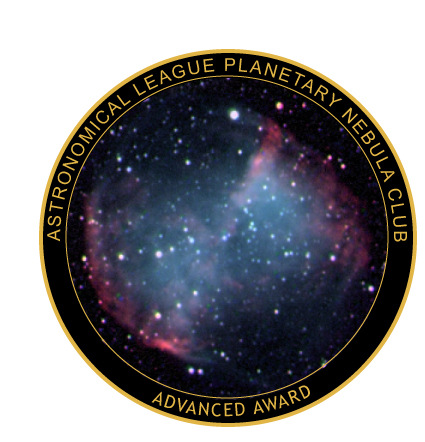
Second, we have acknowledged the possibility that a few of the objects may simply be beyond detection for some observers and will allow negative observations in the completion of the Gold Level. Evidence of diligent effort to observe the object is required (see the observing rules), but actual detection is not. Completion of the AGold Level earns a certificate and pin. The pin sports a colorful image of the Dumbbell Nebula, M27, taken by BBAA member Richard Dickson. To earn the certificate and pin for the Gold Level, you must attempt to observe all 110 objects on the list.
To complete the Observing Program by imaging (this is also a Gold Level), 90 objects must be successfully imaged. Any or all of the four proto-planetary nebulae can be used for the imaging certificate and pin.
Four additional objects are provided as examples of proto-planetary nebulae. Their observation is encouraged but not required.
Requirements and Rules
This certification is available to members of the Astronomical League, either through their local astronomical society or as members at large. If you are not a member and would like to become one, check with your local astronomical society, search for a local society on the Astronomical League Website (click here), or join as a Member-At-Large in the AL Store.
 |
The Planetary Nebula Observing Guide, available from the AL Bookstore, was specifically written to support this observing program. This guide includes the list of 110 planetary nebulae for northern hemisphere observers along with images of the objects and a short list of challenge objects. There is an introduction to planetary nebulae, some historical background, and hints on observing these majestic objects. We strongly encourage you to acquire a copy of this manual.
Device-aided searches and remote telescopes are allowed for this Observing Program. Observers reporting that 100% of the objects observed were located manually by traditional star-hopping techniques will receive special recognition on their certificates. |
 |
“Negative observations” will be accepted for the GOld Level if sufficient evidence is submitted to establish that the proper field was examined on at least two separate attempts and every reasonable effort was made to detect the object. To record a negative observation, the observer must make at least two observing attempts on different nights, record all of the data required for a standard observation and describe in detail the methodology used to confirm that the proper position was examined. Each negative attempt MUST include a sketch of the star field. Observers are encouraged to make as many attempts to detect the object as possible and to submit negative observations only when resigned that detection is impossible. Negative observations WILL NOT be accepted for the Silver Level.
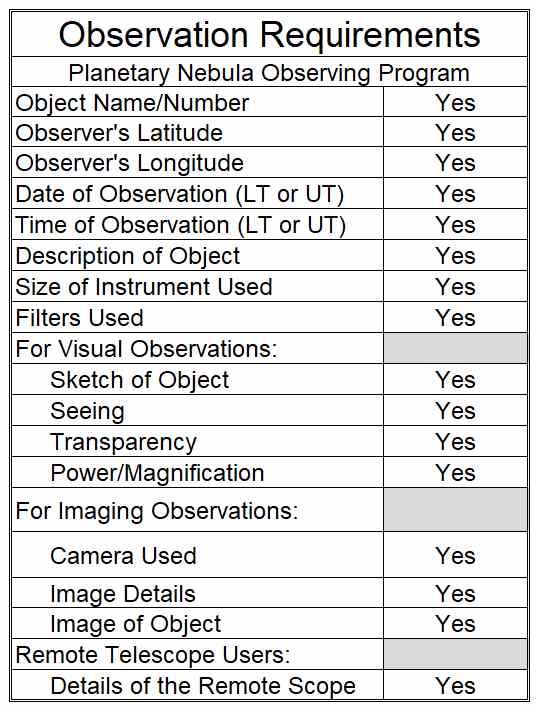
The observer may use the log sheet provided by this program’s observing guide or may use a log of his/her own design so long as all of the required information is recorded. The record of observations shall include for each object:
- Specifics of the observer’s site (latitude and longitude)
- Date and time of the observation (local time or UT)
- Conditions including seeing, transparency, and the darkness of the site, including the degree to which the moon interferes with the observation
- Telescope used including aperture and focal ratio
- Eyepiece and telescope magnification information
- Filters used (if any)
- A detailed description of the object that includes at a minimum:
- Is the central star visible?
- Is a filter required to observe the PN?
- How does the PN respond to different magnifications?
- Is the object visible by direct vision, or does it require averted vision?
- A detailed description of the object’s appearance in the observer’s own words, OR a detailed sketch of the object.
Visual observers are encouraged, but not required, to observe and submit their observations of the four “challenge” objects.
The record of observations for the imaging award shall be the same as for the visual certification, except that instead of a detailed description of the object, the specifics of the instruments used to make the image should be recorded. Additional information relevant to the production of the image such as exposure times, film types, image software, number of stacked images, and the like should be provided.
Any process that records an image through the optics of a telescope may be employed for the imaging certificate and pin.
Submitting for Certification
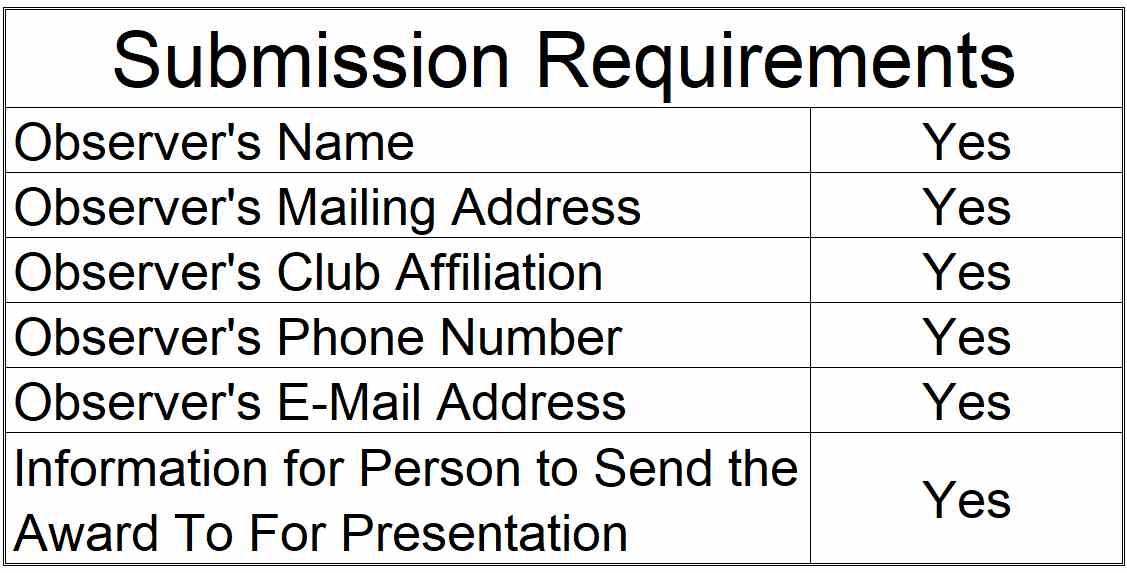
| To receive your certificate and/or pin, mail or email a copy of your observations to the Observing Program Coordinator. Include your name, mailing address, email address, phone number, and society affiliation. Indicate to whom the certification should be sent.
Members-at-Large or members of societies that do not have awards coordinators should submit their logs directly to the Planetary Nebula Observing Program Coordinator. It is recommended that COPIES of your log be sent; we will not return the logs unless the observer provides for postage. |
 |
Imagers should submit images either to their society’s awards coordinator or to the League’s Planetary Nebula Observing Program Coordinator. Images in electronic format may be forwarded by any convenient means that accomplishes transfer or makes the images available for review. This may include mailing a storage device such as a CD or flash drive, or ‘posting’ of the images on the web. Please check with the program coordinator to ensure that the transfer method will be acceptable if images are to be sent. Please avoid sending prints or slides unless you do not require them back.
Upon verification of your submission and of your active membership in the Astronomical League, your recognition (certificate, pin, etc.) will be sent to you or to the awards coordinator for your society, as you specified. Your name will also appear in an upcoming issue of the Reflector magazine and in the Astronomical League’s online database. Congratulations. Good luck with your next observing challenge.
Planetary Nebula Observing Program Coordinator:Ted Forte |
Notes:
Alternate Objects for Northern Observers:
Upon request, a special accommodation will be made for observers whose latitude prevents their observation of the entire list. Observers must contact the Observing Program Coordinator and agree on alternate objects. Substitutions are allowed only for objects that do not rise above the observer’s horizon and must be approved in advance. Observers who have special circumstances such as a fixed telescope inside a permanent observatory whose mounting or location prevents pointing below a certain altitude should contact the Observing Program Coordinator to discuss the issue. Every effort will be made to accommodate the observer’s circumstances providing that the level of Observing Program difficulty remains consistent with the original Observing Program list.
Imagers, too, must receive the prior concurrence of the coordinator to substitute alternate objects for objects on the original list. Imagers will receive wide leeway in the selection of the 90 objects to image for the program as long as the selection is agreed to in advance. This is to allow the flexibility to achieve the most aesthetically pleasing or interesting images.
There are 26 PN in the original Observing Program list that have declinations below -20 degrees. Therefore, 26 alternate planetary nebulae have been selected as suitable replacements with positive declinations. By using all 26 substitutions, an observer at the latitude of the Arctic Circle could presumably complete the Observing Program.
To use the alternate objects, the observer should identify which objects on the original list are inaccessible from his location, and then select an equal number of alternates from the approved list. The total number of objects observed must be at least 110. Alternate objects are not authorized for the basic program. The observer must contact the Planetary Nebulae Observing Program Coordinator in advance to declare the selection of alternates. Once agreed upon, the coordinator will keep the selection on file until the observer completes the program. Observers using alternate objects should submit their logs or images directly to the Planetary Nebulae Observing Program Coordinator. All other guidelines for certification remain the same.
The Southern Planetary Nebula List:
Observers in the southern hemisphere may complete the Planetary Nebula Observing Program by observing the objects listed on the Southern Planetary Nebula Observing Program object list. All of the objects on the original PN Program list with declinations above that of M27, the Dumbbell Nebula (+22°43’16”), have been replaced with objects with negative declinations. This will accommodate observers north of about 60 degrees south latitude.
Southern observers may earn the Silver Level for observing 60 PN and receive a certificate, or observe all 110 objects on the list to receive a Gold Level award which includes a certificate and a pin. Southern imagers may receive the imaging certificate and pin for imaging 90 of the objects on the list.
Observers or imagers who have already received a Gold Level award either visually or through imaging for the original program will not receive a second pin for completing the Southern Planetary Nebula Observing Program. They will, however, receive a certificate specifying that they have completed the Southern PN Program. Observers who have completed the original PN Observing Program, either visually or by imaging, may complete the Southern PN Observing Program by submitting logs or images of the additional objects on the southern list; the duplicated objects need not be re-observed or imaged.
The guidelines for certification remain the same as for the original program and have the same reporting requirements except as noted below in the special rule.
Special Rule:
Visual observers who have completed the original Planetary Nebulae Observing Program may complete the Southern PN Observing Program, and earn a second certificate, by observing or imaging the additional objects on the Southern Planetary List. Imaging by means of a remotely accessed telescope is allowed provided the observer personally selects the objects and directs the acquisition of the imaging. Visual observers completing the program this way will receive a certificate for the visual Southern Planetary Nebula Observing Program and must observe or image all forty of the additional objects. A combination of visual observation and imaging, including remote imaging, of the additional southern objects is allowed. This rule applies ONLY to observers who have completed the original Planetary Nebulae Observing Program. Imaging awards will only be issued when 100% of the tagets submitted were observed through imaging.
NOTE: The list of Southern Planetaries was corrected on August 28, 2012. Two misclassified objects were replaced. (NGC 5408 replaced with NGC 4071 and He 2-172 replaced with He 2-90)
Links:
- Standard List (Excel Format, PDF Format)
- Southern List (Excel Format, PDF Format)
- Alternate Northern List (Excel Format, PDF Format)
- Find Your Observing Program Award