



Urban Observing Program Coordinator:
|
  |
IntroductionWelcome to the Astronomical League’s Urban Observing Program! The purpose of the Urban Observing Program is to bring amateur astronomy back to the cities, back to those areas that are affected by heavy light pollution. Amateur astronomy used to be called “backyard astronomy”. This was in the days when light pollution was not a problem, and you could pursue your hobby from the comfort of your backyard. But as cities grew, so did light pollution, and the amateur astronomer was forced to drive further and further out into the country to escape that light pollution. It is not uncommon today for a city dweller to drive 100 miles to enjoy his/her hobby. But many people do not have the time or the resources to drive great distances to achieve dark skies. That is the reason for the creation of this program, to allow those who want to enjoy the wonders of the heavens in the comfort of their own neighborhoods to do so, and to maximize the observing experience despite the presence of heavy light pollution. |
 |
Our crack team of observers observed the objects on this list from the East Coast to Middle America to the West Coast, and from major metropolitan areas like Miami, Baltimore, Dallas, Houston, and Los Angeles. Limiting magnitudes went from a high of 4, down to 2, to a “Geez” as Becky Schultz commented on one particularly bad evening. Instruments ranged from a six-inch reflector to a ten-inch SCT. So as you can see, there is a world of objects out there that can be enjoyed under even poor skies, and it only takes a small to medium sized telescope to enjoy them. We sincerely hope that this program encourages you to continue your enjoyment of this wonderful hobby of ours.
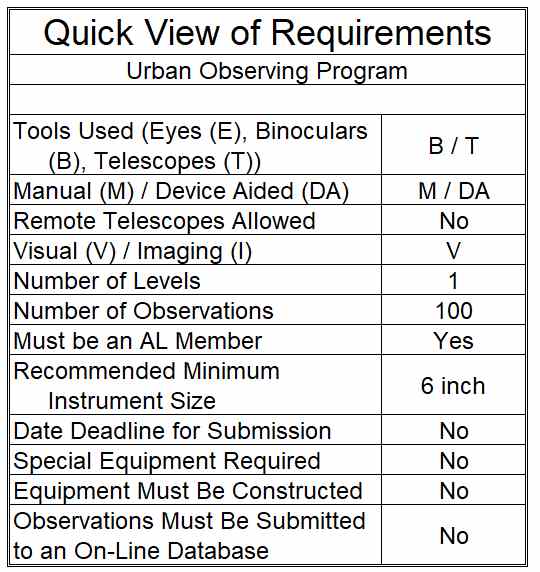
Each Observing Program has unique requirements. After reading this web page, and reviewing the Quick View of Requirements grid, if you have any questions about your equipment or how you plan to do your observations, please contact the Coordinator before you start observing.
Requirements and RulesThis certification is available to members of the Astronomical League, either through their local astronomical society or as members at large. If you are not a member and would like to become one, check with your local astronomical society, search for a local society on the Astronomical League Website (click here), or join as a Member-At-Large in the AL Store. To qualify for the Astronomical League’s Urban Observing Program certificate and pin, observe 100 objects on the Urban Observing Program list in light polluted skies. For the purposes of the Urban Observing Program, light-polluted skies are defined as any skies where you cannot see the Milky Way with the unaided eye.” (As examples, consider dark orange to white; a Bortle Scale of 5 or higher. However, even though these sites do suffer from severe light pollution, if the Milky Way happens to be visible on a given night, that night is not usable.). You may observe the objects with the unaided eye, binoculars or any size telescope. However, telescopes from six to ten inches of aperture are recommended since a larger aperture helps pull out fainter objects in non-contrasty skies. Previous observations of these objects may be used toward this program as long as they were done in light polluted skies. Previous observations from dark sky sites may not be used. All observations made in achieving the certificate for the Urban Observing Program may be used toward certificates of other A.L. Observing Programs. For more information on the Bortle Scale, check out the Wikipedia page. To see this in action check out your local Dark Sky Chart. To get to the list of these sites, click here. Here is an example of a map you get when you dig down. This one is for the Insperity Observatory in Humble, TX. The large white area is Houston, TX. |
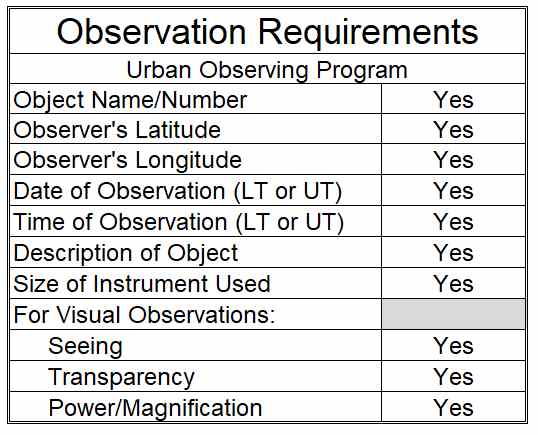 |
To record your observations, you may use log sheets similar to those found in the back of the Astronomical League’s manual Observe: A Guide to the Messier Objects. You can order the Observing manual through AL Store. If you use your own log sheets, they must include:
- object name
- date and time (local or UT)
- seeing and transparency
- latitude and longitude
- type of instrument and magnification
- observing notes. (Observing notes do not have to be extensive. Simply include a phrase or a sentence or two describing what you saw. For example, “A small fuzz ball that couldn’t be resolved in the light pollution”, “A double star comprised of two bright white stars”, etc.)
List of Objects:
There are actually two lists, one for deep-sky objects, and another for double and variable stars. All objects are listed in Right Ascension order so that you can view them as they rise in the East and set in the West.
Information provided on each deep-sky object includes:
- Catalog Number
- Right Ascension and Declination
- Magnitude
- Messier Designation (if any)
- Type of Object, Size
- Constellation
- what chart it is located on in both the Uranometria or Tirion’s Sky Atlas 2000
Information provided on double and variable stars includes:
- Object
- Right Ascension and Declination
- Magnitudes
- Separation of the components
I hope you enjoy this list of objects to observe, and that it helps increase your satisfaction in observing from a light polluted area. I will look forward to your sharing your observations with me. Until then, good luck, clear skies, and good observing.
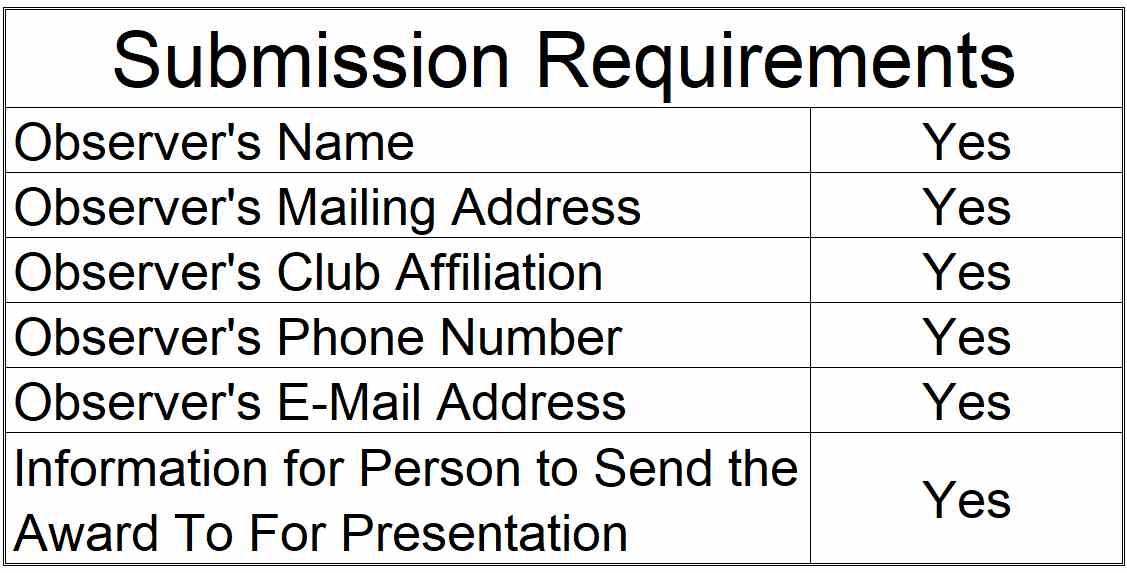
Submitting for CertificationTo receive your certificate and/or pin, mail or email a copy of your observations to the Observing Program Coordinator. Include your name, mailing address, email address, phone number, and society affiliation. Indicate to whom the certification should be sent. Be sure to include your name, mailing address, email address, phone number, society affiliation, and to whom the certification would be sent. |
 |
Upon verification of your submission and of your active membership in the Astronomical League, your recognition (certificate, pin, etc.) will be sent to you or to the awards coordinator for your society, as you specified. Your name will also appear in an upcoming issue of the Reflector magazine and in the Astronomical League’s online database. Congratulations. Good luck with your next observing challenge.
Urban Observing Program Coordinator:
|
Notes:
Acknowledgments:
We wish to gratefully acknowledge Phillips S. Harrington of the Westport Astronomical Society for his suggestion and support in creating this Observing Program.
We also gratefully acknowledge the hard work of the following people who helped to select and check all the objects in the two lists:
- John A Barra – Peoria Astronomical Society
- Ken Boquist – Quad-Cities Astronomical Society
- Bill Geertsen – Harford County Astronomical Society
- David Hasenauer – Texas Astronomical Society of Dallas
- Ire Maisier – Member-at-Large
- Chris Randall – Fort Bend Astronomy Club
- Becky Schulz – Fort Bend Astronomy Club
- Jim Tomney – Baltimore Astronomical Society
- Roberto Torres – Southern Cross Astronomical Society