


Stellar Evolution Observing Program Coordinator:Aaron Clevenson |
 |
Why Version 2.0? And what it means to you.
First let’s address some common concerns:
- If you already have earned your Stellar Evolution certification, no changes for you. There is no new certificates. Although the list contains more targets, the 100 you observed are still on the list.
- If you are currently working on your Sellar Evolution certification, no problems. The 100 objects you observed or are observing are still on the list, but now there are a total of 160 to choose from.
- If you have not started yet – go for it!
Why version 2.0?
- We want to be sure that anyone can achieve this certification, regardless of the hemisphere where they live. So we needed to add more objects for people who live in the southern hemisphere. There are now 160 to choose from.
- We reorganized the lists to more closely align with stellar lifecycles.
- We updated the lists for each category to ensure that the targets in that category fit in.
- We also added options for “Eyes-Only” and “Binocular” certificates.
IntroductionEverything that you see in the night sky is visible to you because of light from a star. The stars themselves, nebulae, planets, and moons, are visible because of starlight. Even dark nebulae are visible because they block the illumination of stars or other objects lit up by stars. We exist because early generations of stars generated the elements that make up our planet and the chemical elements required for life. It is not an understatement to say that we exist because stars exist. The Stellar Evolution Observing Program will be of interest to beginning observers as well as more experienced observers. The purpose of this Observing Program is to develop in the observer an appreciation for the most common objects that they see in the night sky – the stars. Stars, like us, are born, live their lives and end their lives. Understanding this ‘stellar evolution’ is important to understanding how the universe works. Some of the objects in this Observing Program’s list are on other Astronomical League observing lists, so you may have already observed some of the objects. In addition to performing the observations, you will have enough information to put each object into the context of stellar evolution. In the end, observing is something you do in your mind. It’s not about simply seeing the object, it’s about understanding what the object is, why it is important, why it is interesting and how it fits into the story. Once you do, you’ll be able to say ‘Oh, WOW’ for objects that you may have overlooked or may have underappreciated in the past. |
 |
Many of the objects in this list are easy naked eye objects, but some will require a small telescope and some patience to find. Not all stars are bright, and end-of-life stars can be particularly dim. The bright objects will generally be visible from a home in the city or in the suburbs, the dimmer objects will require reasonably dark, but not pristine, skies. A few of the objects will be better seen under clear dark skies with a large telescope.
Each Observing Program has unique requirements. After reading this web page and reviewing the Quick View of Requirements grid, if you have any questions about your equipment or how you plan to do your observations, please contact the Coordinator before you start observing.
Requirements and Rules
This certification is available to members of the Astronomical League, either through their local astronomical society or as Members-at-Large. If you are not a member and would like to become one, check with your local astronomical society, search for a local society on the Astronomical League Website (click here), or join as a Member-At-Large in the AL Store.
| The observing list for this program is divided into several sections each illustrating a separate phase of stellar evolution. To meet the objective of this Observing Program it will be necessary for you to observe objects in all of the categories.
A total of 100 objects must be observed to complete this Observing Program. A log sheet that meets the requirements of this Observing Program is located here. You may use this, or any suitable log that records the required information. Your observing log sheet must include this information for each of the objects:
|
 |
As part of this Observing Program you’ll be looking at, and understanding, the Hertzprung-Russell (H-R) diagram. (An H-R Diagram can be found here.) This diagram was developed independently by Ejnar Hertzsprung and Henry Norris Russell in about 1910. Although there is a lot to be gained from the study of the H-R diagram, its concept is easy. The X (horizontal) axis of the chart represents temperature of the star (color and temperature are the same thing) and the Y (vertical) axis of the chart represents the luminosity of the star. Luminosity is the intrinsic brightness of the star. A star’s magnitude is the brightness of a star as seen from Earth, so a high luminosity star that’s very far away may look dim to us and a lower luminosity star that is nearby may appear brighter to us.
Of course, I hope that you will enjoy learning about stellar evolution and observing the objects in this Observing Program as much as we have enjoyed developing the program.
The Target Categories (to earn the pin and certificate)
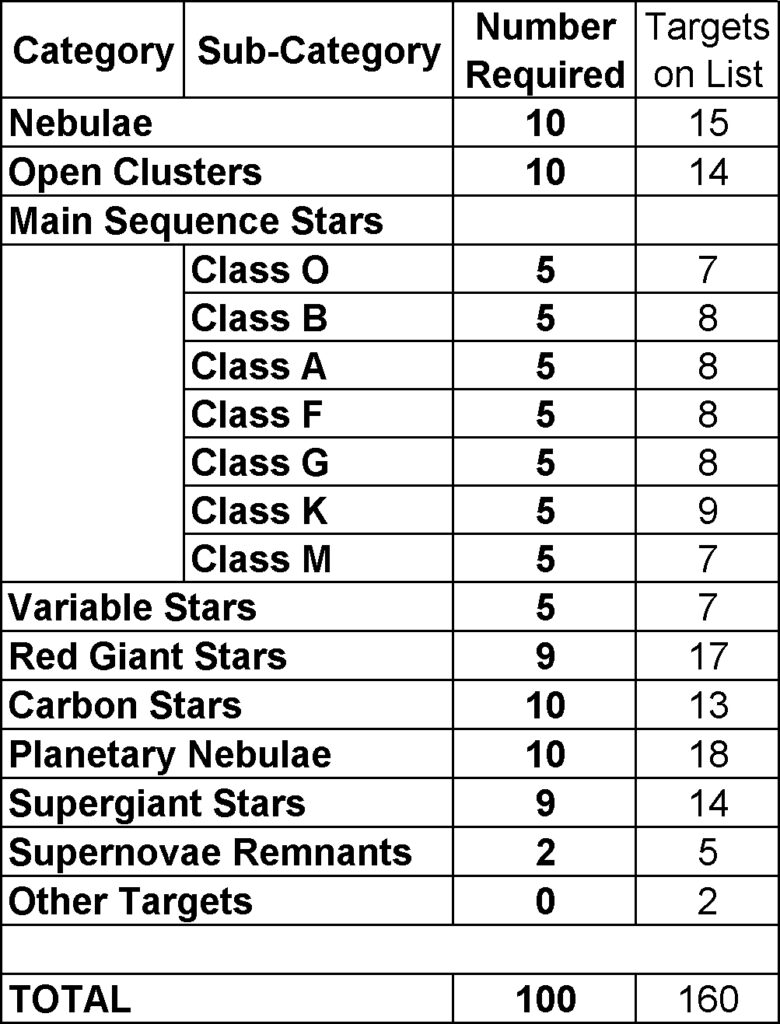
Types and Levels of Certifications
Full Certification: (You will earn a certificate and a pin.) The “Stellar Evolution” Object List (PDF file) can be found here. Those listed in a light blue field are the new ones.
- Regular Certification: Observe 100 targets from the target categories as shown. You may use any means to observe them.
- Imaging Certification: Observe 100 targets from the target categories as shown using imaging. They must be done entirely through imaging.
- Manual Certification: Observe 100 targets from the target categories as shown. They must be found entirely manually.
- Full Binocular Certification: Observe 100 targets from the target categories as shown. They must all be observed using binoculars. This will likely require you to observe from both the northern and southern hemispheres.
Partial Level Certification: (You will only earn a certificate.)
|
Binocular Certificate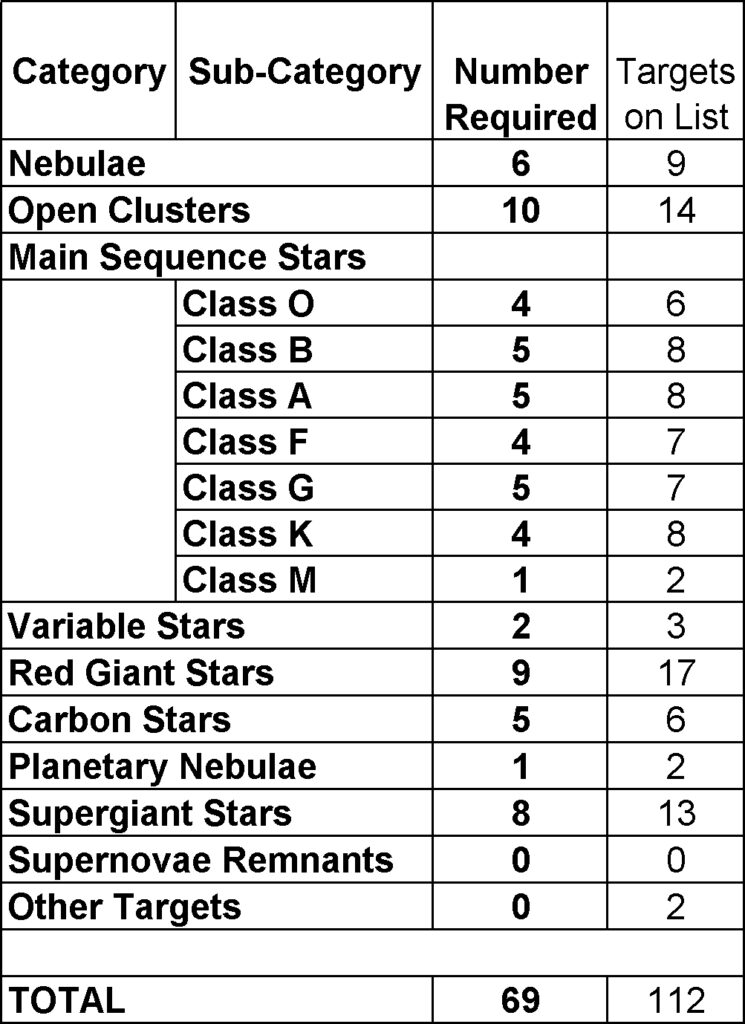 |
Eyes Only Certificate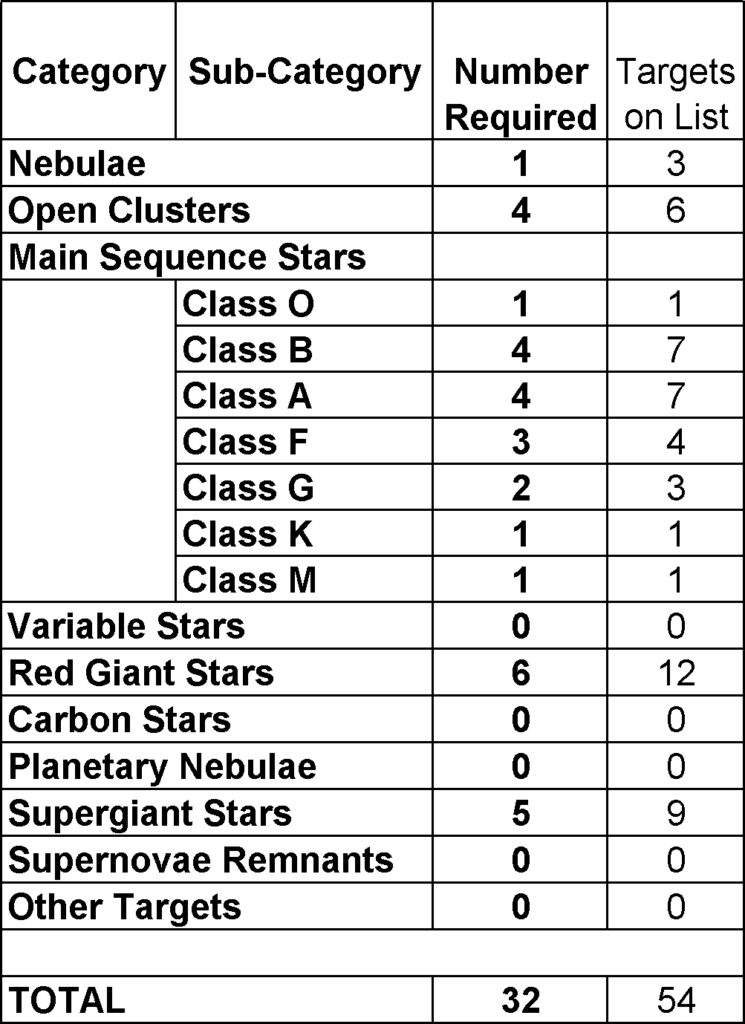 |
Submitting for CertificationTo receive your certificate and/or pin, send a copy of your observations to the Observing Program Coordinator by email or mail. Include your name, mailing address, email address, phone number, and society affiliation. Indicate to whom the certification should be sent. |
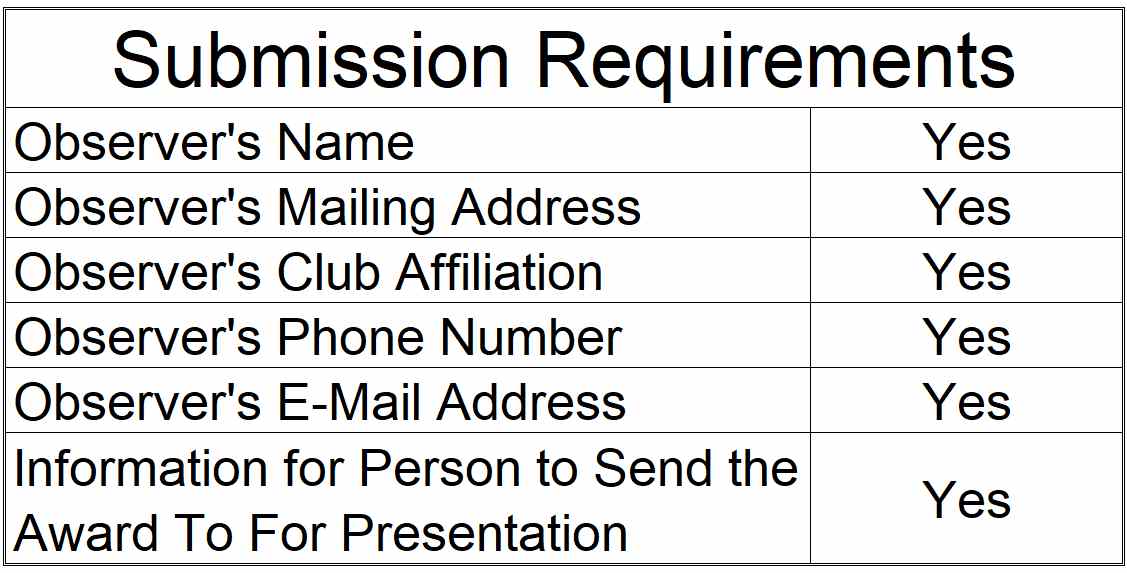 |
Stellar Evolution Observing Program Coordinator:Aaron Clevenson |
Upon verification of your submission and of your active membership in the Astronomical League, your recognition (certificate, pin, etc.) will be sent to you or to the awards coordinator for your society, as you specified. Your name will also appear in an upcoming issue of the Reflector magazine and in the Astronomical League’s on-line database. Congratulations. Good luck with your next observing challenge.
References:
- H-R Diagram
- Stellar Evolution Log Sheet (PDF file)
Links:
- “Stellar Evolution” Object List (PDF file) – those listed in a light blue field are the new ones.
- The Stellar Evolution Observing Manual is available in the AL Store.
- Find Your Observing Program Award