

Swift Observing Program Coordinator:Dave Hasenauer |
 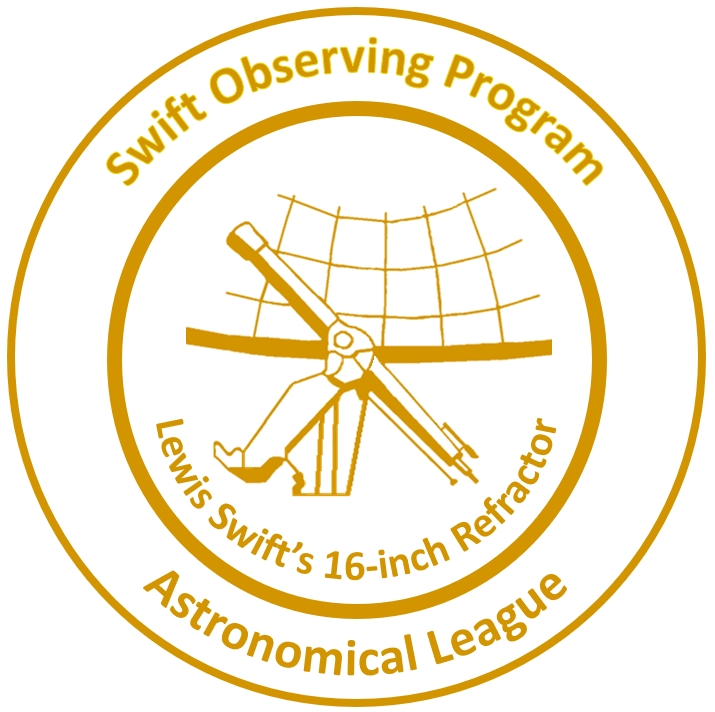 |
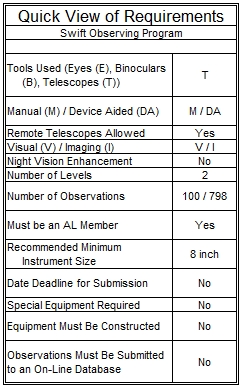
IntroductionLewis Swift (February 29, 1820 – January 5, 1913) was the most prolific discoverer of new NGC & IC objects from the Americas. For most of his life, he was an amateur astronomer and very successful comet hunter (13 discoveries/co-discoveries), including P/109 Swift-Tuttle, the source for the August Perseid meteor shower. His day job was as a hardware store owner in Rochester, NY. As his fame grew with the discovery of new comets, as well as his popular public lectures, newspaper articles, and astronomical outreach with his 4.5” refractor, a local wealthy patron offered to build him an observatory and provide an annual stipend if the residents of the city of Rochester would purchase a large telescope for him. The residents came through and in 1883 Swift embarked on his professional astronomy career at the age of 63. The city purchased a 16” f/16.5 Alvan Clark refractor, the 4th largest in the United States at that time. Other wealthy members of the community purchased spectroscopes, a sidereal clock, and other ancillary instruments. His primary patron, H. H. Warner provided the land and funds for the Warner Observatory (and residence) where Swift operated until 1893, when Warner lost his fortune in the financial panic of that year. Swift was invited to come to Southern California by Thaddeus Lowe and established the Mount Lowe (aka Echo Mountain) Observatory, bringing the 16” refractor with him. The observatory was located above Pasadena, on a peak about 2000-feet below the now more famous Mount Wilson Observatory. Swift served as director of the Mount Lowe Observatory until failing eyesight resulted in his retirement in 1901 and his return to Western New York. This program requires observing 100 objects selected from Swift’s discoveries. Swift is credited with the discovery of over 1050 NGC & IC objects. However, after removing duplicate discoveries, independent discoveries of objects previously found by other observers, non-deep sky objects (e.g., very faint star groupings that appeared nebulous in his 16” scope), and objects that could not be independently verified, the total number of his NGC/IC DSO discoveries is 798 objects. Each Observing Program has unique requirements. After reading this web page, and reviewing the Quick View of Requirements grid, if you have any questions about your equipment or how you plan to do your observations, please contact the Coordinator before you start observing. |
 |
Requirements and Rules
This certification is available to members of the Astronomical League, either through their local astronomical society or as members at large. If you are not a member and would like to become one, check with your local astronomical society, search for a local society on the Astronomical League Website (click here), or join as a Member-At-Large in the AL Store.
There are two levels of this certification:
- Regular Award: 100 observations of your choosing from the list. You will receive a certificate and a pin.
- Complete Award: All 798 observations from the list. You will receive a “Complete” certificate.
Each observation must include:
|
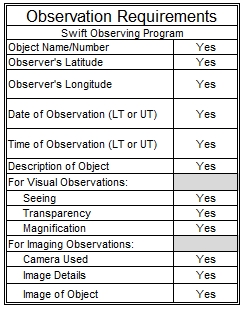 |
Note that visually, many of these objects will require larger aperture instruments and dark skies, but all were discovered using Swift’s 16” refractor, or smaller instruments
When you have completed the required observations, send a copy of your observing notes and contact information (see below) to the Observing Program Coordinator. Please note, send copies only, the observing notes will not be returned to you.
The provided checklist was derived from a file created by Dr. Wolfgang Steinicke FRAS (http://www.klima-luft.de/steinicke/index_e.htm) who meticulously researched the discoveries of objects in the NGC & IC. For those interested, much more background can be found on his website, and in his book, “Observing and Cataloguing Nebulae and Star Clusters – From Herschel to Dreyer’s New General Catalog” (Cambridge University Press, © 2010).
For an excellent biography of Lewis Swift, see “Lewis Swift: Celebrated Comet Hunter and the People’s Astronomer”, by Gary Kronk (Springer Publishing, © 2017).
Submitting for Certification
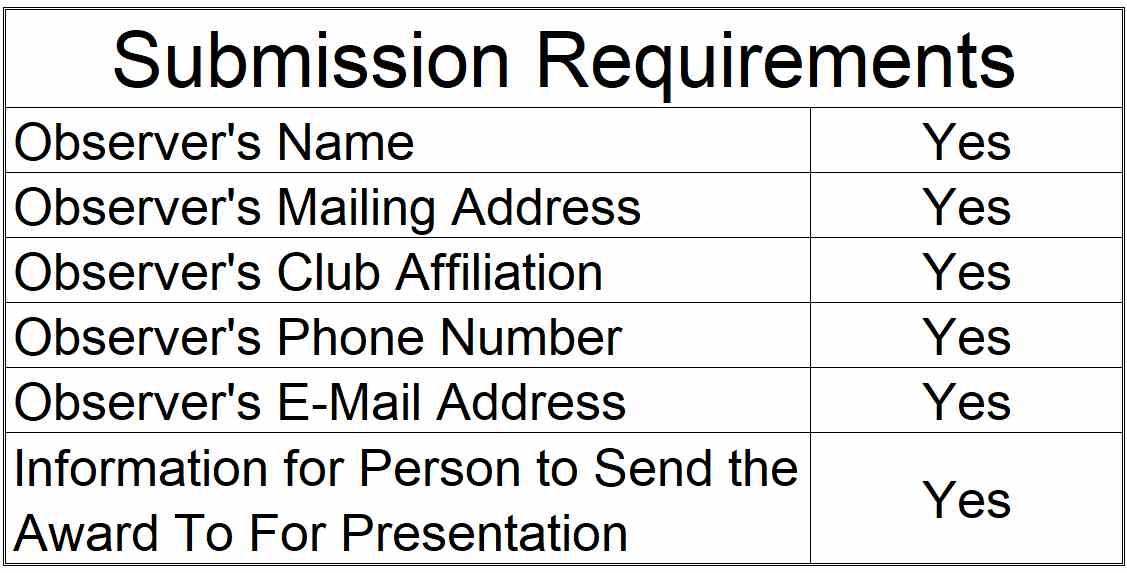
To receive your Swift Observing Program certificate and/or pin; mail or email a copy of your observations to the A.L.’s Swift Observing Program Coordinator. Include your name, mailing address, email address, phone number, and society affiliation. Indicate to whom the certification should be sent.
Swift Observing Program Coordinator:Dave Hasenauer |
 |
Links:
- Swift Observing Program Object List (Excel format, PDF format)
- Swift Observing Program Object Checklist (Excel format, PDF format)
- Swift Observing Program pin
- Find Your Observing Program Award