



Hang on to your hat! The Universe is there for the taking.
Your challenge is to decide the best path for YOUR observing plan. The options are many and diverse. The Astronomical League offers more than 85 options to choose from and most of them use telescopes.
Questions that can help you fine tune your direction:
- What do I want to do? What interests me in Astronomy? What do I want to experience or learn more about?
- What is your experience level? Novice, intermediate, experienced?
- Manual, Device-Aided, Fully Automated Telescopes, or Remote Telescopes? Some Observing Programs require Manual target finding, Device-Aided Telescopes are usually more expensive than Manual Telescopes.
- Visual (using your eyes at an eyepiece) or Imaging (using a camera)? Imaging usually requires the purchase of additional equipment and significant learning.
- We are already at the Telescope level, but the next consideration is how big is your telescope? Some Observing Programs are suitable to almost any telescope, others require a large aperture (diameter) telescope (often called a light-bucket).
The pinnacle achievement of Eyes-Only Observing is the Master Observer Progression. These levels are part of the Progression:
- For Your Eyes Only Award
- Binocular Master Observer Award
- Observer Award
- Master Observing Award
- Master Imager Award
- Advanced (Master) Observer Award (requires Observer and Master Observer/Master Imager Awards)
- Master Observer – Silver Award (requires Advanced Observer Award)
- Master Observer – Gold Award (requires Master Observer Silver Award)
- Master Observer – Platinum Award (requires Master Observer Gold Award)
- Master Observer – Triple Crown Award (requires Master Observer Platinum, Binocular Master, and Master Imager Awards)
There are also guides to help you navigate the many Observing Programs:
- Observing Programs (listed alphabetically).
- Observing Program Selector Grid.
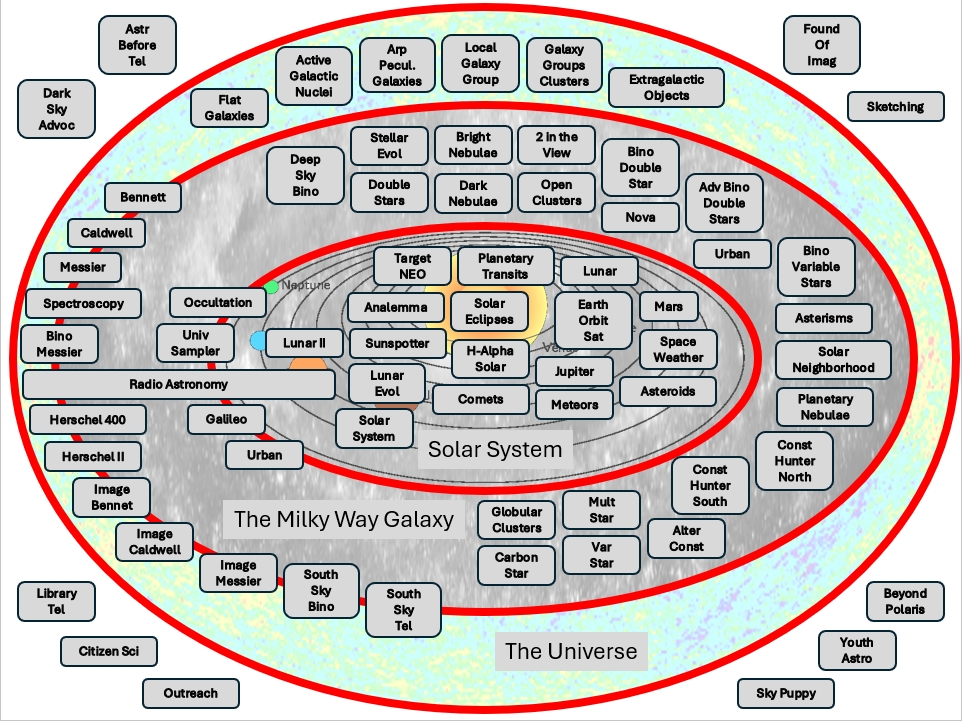
- Observing Program Relationship Graphic.
Clear Skies and may you have many hours of rewarding observing.