


Variable Star Observing Program Coordinator:Robert “Rocky” Togni |
 |
Introduction
| Welcome to the Astronomical League’s Variable Star Observing Program! This is a joint program of the Astronomical League and American Association of Variable Star Observers. It uses AAVSO resources and provides valuable data for Astronomers and researchers.
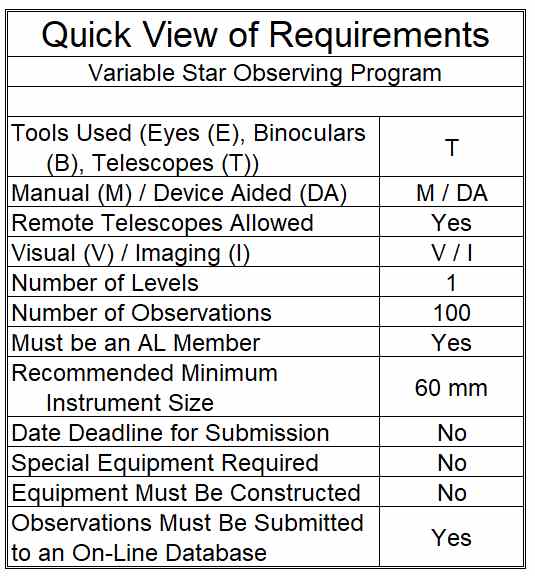
Much that we know about stars and the universe came from studying variable stars. There are over 200,000 variable stars catalogued with many more suspected. With modest equipment any amateur can make observations that are valuable scientific contributions. The minimum required equipment for this award is a pair of binoculars, but any size telescope or go-to telescope can be used. Variable stars are objects whose light is not constant. The observer’s goal is to determine the brightness of the star when compared to stars of fixed brightness in or near the same field of view. The thrills of variable star observation are many – finding the right star in the patterns in the field; pushing the limits of your telescope and your observational skills to glimpse that mag 14.5 star; improving your observing methods, equipment, and ability to yield more and more variables per observing session; seeing your favorite stars change in brightness as you watch them from week to week; catching SS Cygni in outburst. You get all this plus you get to provide useful scientific data to scientists and other observers. Each Observing Program has unique requirements. After reading this web page, and reviewing the Quick View of Requirements grid, if you have any questions about your equipment or how you plan to do your observations, please contact the Coordinator before you start observing. |
 |
Requirements and Rules
This certification is available to members of the Astronomical League, either through their local astronomical society or as members at large. If you are not a member and would like to become one, check with your local astronomical society, search for a local society on the Astronomical League Website (click here), or join as a member at large (click here).
| To qualify for the Astronomical League’s Variable Star Observing Program certificate and pin, complete these observing requirements:
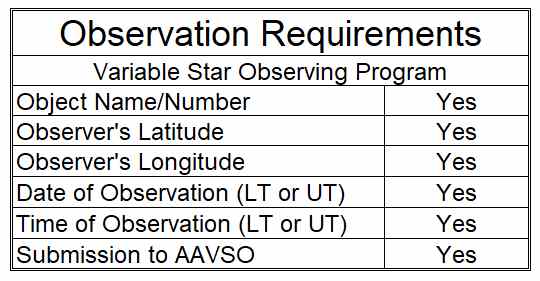
1. Make a total of 100 observations of at least 15 different Long Period (Mira), Semiregular (Betelgeuse), or Cataclysmic (SS Cygni) variables. At least one long period variable should be followed through a complete cycle. Observations must include the object name, your location including latitude and longitude, sky conditions including seeing and transparency, and the date and time (local or UT). 2. Optional. Recommended for beginners. Cepheid – Observe Delta Cephei, Eta Aquilae, or another Cepheid through a complete cycle making observations nightly or through several cycles if weather doesn’t permit nightly viewing. Plot results on a light curve vs. time. Counts as 10 of your 100 observations. 3. Optional. Recommended for beginners. Binary – Observe Algol (B Persei), B Lyrae, or another binary through an eclipse or minima. Make estimates as applicable to star’s period, for example Algol might be made every 15 minutes while Beta Lyrae might be observed nightly for a couple of weeks. Plot results on a light curve vs. time. Counts as 10 of your 100 observations. Charts of these unaided eye variables and more are in the 10 Star Tutorial at the online resources link listed below. |
 |
Only AAVSO charts from the Variable Star Plotter on the AAVSO website or charts from the 10 Star tutorial may be used for determining Variable brightness to complete this program. All observations made in this program are to be submitted to the AAVSO database and will be used by scientists and other amateurs to advance our knowledge of the stars.
Any telescope 60 mm or larger or binoculars of at least 50mm objective are adequate to do this Observing Program. You may use star hopping or go-to telescopes. There is an AAVSO CCD program for observing variable stars. It requires much more expensive equipment and is more time consuming, but yields results for stars not reachable by visual observers. CCD observations correctly submitted to AAVSO are acceptable for this program.
Submitting for Certification
| To receive your Variable Star Observing Program certificate and pin; mail or email a copy of your observations to the A.L.’s Variable Observing Program Coordinator. An AAVSO printout of your observations is also acceptable. Include your name, mailing address, email address, phone number, and society affiliation. Also include your AAVSO user name so submissions can be confirmed. Indicate to whom the certification should be sent. | 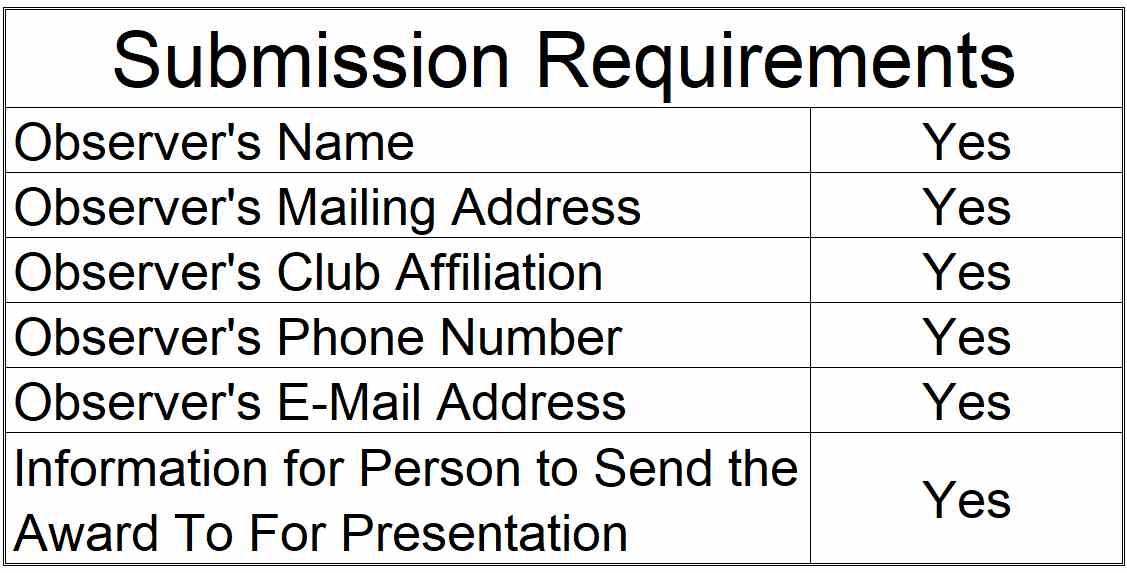 |
Upon verification of your submission and of your active membership in the Astronomical League, your recognition (certificate, pin, etc.) will be sent to you or to the awards coordinator for your society, as you specified. Your name will also appear in an upcoming issue of the Reflector magazine and in the Astronomical League’s on-line database. Congratulations. Good luck with your next observing challenge.
Variable Star Observing Program Coordinator:Robert “Rocky” Togni |
Notes:
Citizen Science: If you enjoyed this Observing Program, and look forward to doing more observations to submit to the national or international database, then we invite you to participate in the Astronomical League’s Citizen Science Program. This is an extension of this Observing Program and only requires you to do what you have been doing; observing and submitting those observations. For more information about this opportunity, please go to the website: Citizen Science Program.
Links:
- Getting Started with Variable Star Observing
- VSOP Log Sheet – MS Excel file
- VSOP Log Sheet – PDF file
- AAVSO Long Period Variable Star Target List
Resources:
The AAVSO website has a wealth of information to help you get started. The following link has the resources listed below and many more.
- AAVSO Online Resources Included is the AAVSO Visual Observing Manual. This is a great reference and learning tool.
- Variable Star Telescope Simulator– MS PowerPoint training presentation
- 10 Star Tutorial– Naked eye stars including binaries and Cepheids listed above.
- Stars Easy to Observe A good list of stars to start observing
- Request an Observer Code. This will be needed to submit your estimates
- Charts Download charts using the Variable Star Plotter
- Find Your Observing Program Award