Winning Clubs of the 2015 Horkheimer Library Telescope Program
Lorem ipsum dolor sit amet, consectetur adipiscing elit. Ut suscipit elit sed diam ultrices hendrerit. Vestibulum feugiat, urna eget ullamcorper tristique, est erat egestas diam, ac imperdiet libero neque sed velit. Curabitur fringilla tortor vitae nisi mattis, dignissim faucibus purus dictum. Sed vel volutpat sapien. Morbi quis tristique dolor. Fusce nec mattis diam. Duis rutrum vitae erat vel fringilla.
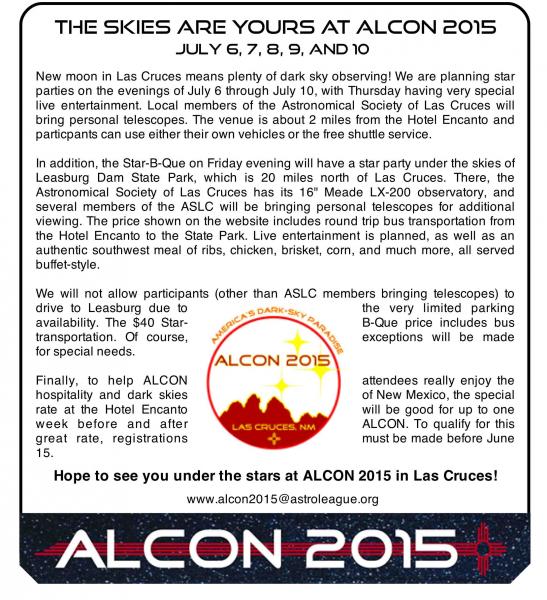
ALCon 2015 is a great opportunity to see the amateur astronomical community in action. Why not visit Las Cruces in July for an incredible firsthand experience? But first, why not visit this website to learn more about what Las Cruces and ALCon offer the amateur astronomer?
If you would like to be added to automatically receive the monthly What’s Up Doc?, please send an email to Aaron Clevenson at aaron@clevenson.org
This is a monthly newsletter created by Aaron Clevenson, one of the National Observing Program Directors and the Insperity Observatory in Humble, TX. It is a listing of many objects that will be visible in the evening sky each month based on the Astronomical League’s Observing Programs. It is primarily oriented towards the introductory level programs.
The next issue will be sent on April 30.
The deadline for submitting nominations for the three Horkheimer Youth Service Awards – Horkheimer/Smith, Horkheimer/Parker, and Horkheimer/D’Auria – has been extended to April 30, 2015.
If you know an Astronomical League member, 18 years or younger, who has brought amateur astronomy to your club or to the public through outreach, presentations, writing, or observing, please consider nominating that person for the three Horkheimer Service Awards.
If you are a club officer, nominate them. If you don’t, no one else will! Complete information about Horkheimer Youth Service awards can be found at https://www.astroleague.org//al/awards/horkhmr/horkhmrs.html
Walter Haas, Founder of the ASLC and ALPO, passed away Monday morning, April 6 at 6:10 am.
A viewing will be available on Monday, April 13 at Lapaz-Graham Funeral Home, 555 West Amador, Las Cruces from 5:00 pm until 8:00 pm. Services will be held on Tuesday, April 14, at the First Presbyterian Church, 200 East Boutz, at 10:00 am.
At the request of the family, donations may be made to either your local hospice, or to the Association of Lunar and Planetary Observers, ALPO, attention Matthew Will, PO Box 13456, Springfield, IL 62791.
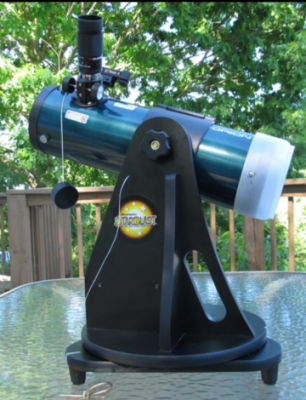
Through the vision of the Horkheimer Charitable Fund, the Astronomical League is offering a free Library Telescope to a lucky Astronomical League club in each of the ten AL regions. The Library Telescope consists of an Orion 4.5 inch StarBlast Dobsonian (or equivalent) and a Celestron 8-24 mm zoom eyepiece (or equivalent), and a name plate commemorating the late Jack Horkheimer. The value of this opportunity is approximately $300; the potential of the program is enormous.
The Library Telescope Program was initiated by the New Hampshire Astronomical Society. Clubs donate an easy-to-use, portable telescope with quality optics and a sturdy mount to their local library. Patrons can then check it out as they do books. Full details of this wonderful program can be found at https://www.astroleague.org/library-telescope-program
The winning entry for each region will be drawn at the annual Astronomical League Business meeting held at ALCon in Las Cruces on about July 11. Only one club per region will win for a total of ten telescope–eyepiece combinations being presented. The telescope, eyepiece, and accompanying commemorative plate will be mailed to the winning clubs in the two weeks following ALCon.
By entering the drawing for the telescope, the club agrees to modify the telescope and zoom eyepiece, and have the telescope library-ready within three months of receipt. The Astronomical League would like a photograph of the modified telescope being presented to the library. It may be used in the Reflector and may be used at some point as promotional material.
Submit the completed entry form to HorkheimerLiTel@astroleague.org so that the Astronomical League national office receives it by July 1, 2015. If mailed, the entry should be postmarked no later than July 1, 2015.
Global Astronomy Month (GAM), organized each April by Astronomers Without Borders, is the world’s largest global celebration of astronomy. GAM 2015 brings new ideas and new opportunities, again bringing enthusiasts together worldwide to celebrate Astronomers Without Borders’ motto “One People, One Sky.” See more at: http://astronomerswithoutborders.org/

MOUNTAIN VIEW – On July 14, NASA’s New Horizons spacecraft will fly past Pluto, offering the first close-up look at that small, distant world and its largest moon, Charon. These denizens of the outer solar system will be transformed from poorly seen, hazy bodies to tangible worlds with distinct features.
Now, the public can help decide what labels will go on the images and maps coming from the flyby. The SETI Institute has announced the launch of its “Our Pluto” campaign, which is soliciting input on how to name features on the surfaces of Pluto and Charon.
“Pluto belongs to everyone,” says New Horizon science team member Mark Showalter, a senior research scientist at the SETI Institute. “So we want everyone to be involved in making the map of this distant world.”
The science team will not have time to come up with names during the quick flyby, so they must assemble a library of names in advance. Consequently, they are inviting the public to visit the web site http://ourpluto.seti.org where they can vote for the names they think should be used to identify the most prominent features on both Pluto and Charon. They can also suggest additional names. These must be associated with a set of broad themes related to mythology and the literature and history of exploration.
After the campaign ends on April 7, the New Horizons team will sort through the names and submit their recommendations to the International Astronomical Union (IAU). The IAU will decide how the names are used.
Currently, the best images of Pluto from the Hubble Space Telescope provide just a hint of what might be in store for the New Horizons cameras. It shows a world marked by sharp contrasts, with some areas as dark as asphalt and others as bright as snow.
“The Pluto flyby this summer will be a major milestone in planetary exploration,” said Alan Stern, Principal Investigator of the New Horizons project. “We are really looking forward to hearing the public’s ideas for feature naming on Pluto and Charon.”
Showalter led the teams that used the Hubble Space Telescope to discover the two smallest known moons of Pluto, Kerberos and Styx. Those satellites were also named via a public campaign.
“The difference is that last time we only needed two names, whereas now we could need more than a hundred,” Showalter notes. “We are eager to gather recommendations from people all over the world.” The web site also includes an extremely simple ballot to allow young children to participate.
More information about the New Horizons mission: